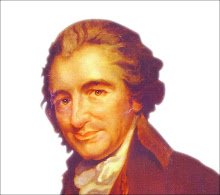
Brief, charming and ACCURATE essay on Tom Paine's iron bridge:
http://www.common-place.org/vol-05/no-04/talk/
Tuesday, October 18, 2011


Friday, September 23, 2011
Thomas Paine on property.
"All accumulation, therefore, of personal property, beyond what a man's own hands produce, is derived to him by living in society; and he owes on every principle of justice, of gratitude, and of civilization, a part of that accumulation back again to society from whence the whole came."
Thomas Paine, Agrarian Justice, Pt. 3.
Thomas Paine, Agrarian Justice, Pt. 3.
Wednesday, August 10, 2011
The poison pill dealt the American Revolution
Money as Debt video -- a short critique:
Several colleagues and friends have pointed out a video on Google Videos entitled Money as Debt. The link is here:
http://video.google.com/videoplay?docid=-2550156453790090544&hl=en
This video is, in fairness, a good attempt to make sense of the problem in a manner that the average rube can relate to -- namely, an oversimplified cartoon. But it strikes me first as vastly inadequate because all it does is describe a problem without suggesting the solution. And, in fact, the "problem description" itself is inadequate -- oversimplified and at some points inaccurate. They're on the right track, but I personally would not recommend the video. The fundamental issue here is not credit itself ... or usury -- that isn't ever going to go away -- at least I don't believe so. The issue is WHO gets the vig -- or interest. When the interest from currency creation goes into private hands, then the citizenry and the economy are constantly being bled and greed becomes the driving force --- thereby leading to extreme fractional reserve ratios, exotic credit and investment instruments and a host of ills. Take that away, put the benefit of currency creation back into the hands of the citizenry though development of education, infrastructure, research, medical care, etc. and the problem goes away. Take currency creation out of the hands of private capital, period. I would argue that is what Article I, Section 8 of the Constitution was intended to do ... but Hamilton talked the Congress into outsourcing the job -- from where I stand, that was the poison pill dealt to the American Revolution.
--
© Kenneth W. Burchell 2011, All Rights Reserved.
Several colleagues and friends have pointed out a video on Google Videos entitled Money as Debt. The link is here:
http://video.google.com/videoplay?docid=-2550156453790090544&hl=en
This video is, in fairness, a good attempt to make sense of the problem in a manner that the average rube can relate to -- namely, an oversimplified cartoon. But it strikes me first as vastly inadequate because all it does is describe a problem without suggesting the solution. And, in fact, the "problem description" itself is inadequate -- oversimplified and at some points inaccurate. They're on the right track, but I personally would not recommend the video. The fundamental issue here is not credit itself ... or usury -- that isn't ever going to go away -- at least I don't believe so. The issue is WHO gets the vig -- or interest. When the interest from currency creation goes into private hands, then the citizenry and the economy are constantly being bled and greed becomes the driving force --- thereby leading to extreme fractional reserve ratios, exotic credit and investment instruments and a host of ills. Take that away, put the benefit of currency creation back into the hands of the citizenry though development of education, infrastructure, research, medical care, etc. and the problem goes away. Take currency creation out of the hands of private capital, period. I would argue that is what Article I, Section 8 of the Constitution was intended to do ... but Hamilton talked the Congress into outsourcing the job -- from where I stand, that was the poison pill dealt to the American Revolution.
--
© Kenneth W. Burchell 2011, All Rights Reserved.
Thomas Paine: schoolmasters v priests.
"One good schoolmaster is of more use than a hundred priests."
Thomas Paine, Worship and Churchbells: A letter to Camille Jordan, 1797.
Thomas Paine, Worship and Churchbells: A letter to Camille Jordan, 1797.
Tuesday, August 9, 2011
Tom Paine lays out the issues then and now
"... a remarkable series of eight letters To the Citizens of the United States and Particularly to the Leaders of the Federal Faction (1802-5) ... addressed the principal political and social controversies of the (Early Federal) era: pre-emptive war; government as a profitable monopoly; curtailment of constitutional rights in the name of security; the unitary executive; abuse of political and governmental power; the privatization of national currency creation; jingoism and war-whoop mentality; conservative retrenchment in the past versus transformational radicalism; and the place of religion in the public sphere."
Kenneth Burchell, ed. Thomas Paine and America, 1776-1809 (London: Pickering & Chatto, 2009), 1:x.
Kenneth Burchell, ed. Thomas Paine and America, 1776-1809 (London: Pickering & Chatto, 2009), 1:x.
Tuesday, July 19, 2011
Thomas Paine -- "What we obtain to cheap ..."
"Tyranny, like hell, is not easily conquered; yet we have this
consolation with us, that the harder the conflict, the more glorious
the triumph. What we obtain too cheap, we esteem too lightly: it is
dearness only that gives every thing its value. Heaven knows how to
put a proper price upon its goods; and it would be strange indeed if
so celestial an article as FREEDOM should not be highly rated."
Thomas Paine, The American Crisis I, December 23, 1776.
consolation with us, that the harder the conflict, the more glorious
the triumph. What we obtain too cheap, we esteem too lightly: it is
dearness only that gives every thing its value. Heaven knows how to
put a proper price upon its goods; and it would be strange indeed if
so celestial an article as FREEDOM should not be highly rated."
Thomas Paine, The American Crisis I, December 23, 1776.
Subscribe to:
Posts (Atom)

 Posts
Posts