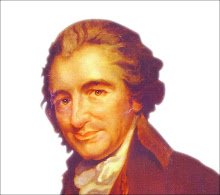
"Gold and silver are the emissions of nature: paper is the emission of
art. The value of gold and silver is ascertained by the quantity which
nature has made in the earth. We cannot make that quantity more or
less than it is, and therefore the value being dependent upon the
quantity, depends not on man. Man has no share in making gold or
silver; all that his labors and ingenuity can accomplish is, to
collect it from the mine, refine it for use and give it an impression,
or stamp it into coin.
Its being stamped into coin adds considerably to its convenience but
nothing to its value. It has then no more value than it had before.
Its value is not in the impression but in itself. Take away the
impression and still the same value remains. Alter it as you will, or
expose it to any misfortune that can happen, still the value is not
diminished. It has a capacity to resist the accidents that destroy
other things. It has, therefore, all the requisite qualities that
money can have, and is a fit material to make money of — and nothing
which has not all those properties can be fit for the purpose of
money.
Paper, considered as a material whereof to make money, has none of the
requisite qualities in it. It is too plentiful, and too easily come
at. It can be had anywhere, and for a trifle.
There are two ways in which I shall consider paper.
The only proper use for paper, in the room of money, is to write
promissory notes and obligations of payment in specie upon. A piece of
paper, thus written and signed, is worth the sum it is given for, if
the person who gives it is able to pay it, because in this case, the
law will oblige him. But if he is worth nothing, the paper note is
worth nothing. The value, therefore, of such a note, is not in the
note itself, for that is but paper and promise, but in the man who is
obliged to redeem it with gold or silver.
Paper, circulating in this manner, and for this purpose, continually
points to the place and person where, and of whom, the money is to be
had, and at last finds its home; and, as it were, unlocks its master's
chest and pays the bearer.
But when an assembly undertakes to issue paper as money, the whole
system of safety and certainty is overturned, and property set afloat.
Paper notes given and taken between individuals as a promise of
payment is one thing, but paper issued by an assembly as money is
another thing. It is like putting an apparition in the place of a man;
it vanishes with looking at it, and nothing remains but the air."
Thomas Paine, Dissertations on government, the affairs of the bank, and paper money (1786).
Friday, May 20, 2011


Thomas Paine -- Society and Government
"GREAT part of that order which reigns among mankind is not the effect of government. It had its origin in the principles of society and the natural constitution of man. It existed prior to government, and would exist if the formality of government was abolished. The mutual dependence and reciprocal interest which man has upon man, and all parts of a civilized community upon each other, create that great chain of connection which holds it together. The landholder, the farmer, the manufacturer, the merchant, the tradesman, and every occupation) prospers by the aid which each receives from the other, and from the whole. Common interest regulates their concerns, and forms their laws; and the laws which common usage ordains, have a greater influence than the laws of government. In fine, society performs for itself almost every thing which is ascribed to government." Thomas Paine, Rights of Man, Part Second, Chapter 1.
Monday, May 2, 2011
The account of Thomas Paine's drunkenness by American portrait painter John Wesley Jarvis.
In consideration of a recent question:
"Both Fruchtman and Keane mention Jarvis's account of Paine's drinking.
"Both Fruchtman and Keane mention Jarvis's account of Paine's drinking.
What's your opinion of Jarvis's assertions? Does Kaye get into it?"
The answer to this question goes all the way back to Cheetham's attack-bio of Paine -- yes, the one that he published immediately after Paine's death in order to avoid a libel or slander suit that Paine had threatened. In his malicious and defamatory biography, Cheetham wrote:
"He did not constantly drink to excess, yet he frequently got excessively tipsy. Once Mr. Jarvis knew him to abstain from liquor two weeks. He had fits of intoxication, and when these came on, he would sit up at night, tippling until he fell off his chair. Disposed to listen to his conversation, Mr. Jarvis sat with him one night from twelve to three, doing all he politely could to keep him sober. At three he left him at his bottle. At four he returned to the room and found him drunk on the floor. Mr. Jarvis wished to raise him up, but Paine desired to lie still. I have vertigo, the vertigo, said he. Yes, said Mr. Jarvis, taking up the bottle and looking at its diminished contents, you have it deep -- deep!" [Cheetham, Life of Thomas Paine, 274-5]
Now, Jack Fruchtman wrote that "Jarvis thought he [Paine - author] sometimes drank too heavily, although he never accused him of being an alcoholic or drunkard." Jarvis was abstemious and religious, so he probably thought ANY elevated drinking was too much. And besides, as we shall see further along, Jarvis strongly repudiated Cheetham's account. What is interesting here is that Fruchtmans only citation for his allegation that "Jarvis thought he sometimes drank too heavily" was the Paine biography of Gilbert Vale [p.153] which makes no like proposition and it was Gilbert Vale who, more than any Paine biographer, repudiated the mythology of Paine's supposed drunkenness. While this would be loose scholarship in a more academic context, Fruchtman's bio is a popular work and cited more loosely as is characteristic of the genre.
John Keane's biography of Paine is perhaps the most intensively researched and cited of all Paine biographies and I have written elsewhere that it is an indispensable work for the library of any Paine scholar or enthusiast. It is not, however, without difficulties -- one of which is his frequent use of Cheetham's attack-biography without disclosure of its use or citation to Cheetham. I have documented a number of places where Keane resorted to Cheetham's account without disclosure or citation. The present account is one of them. On page 524 of his biography he repeated Cheetham's account almost word-for-word .... without any citation for his source. Did he simply overlook the citation to Cheetham's account? Keane's persistent use of Cheetham in his biography without attribution certainly gives the impression of a more systemic oversight or systematic omission.
Cheetham's biography is not now nor has it ever been reliable. Cheetham was a convicted and notorious libeler who was in fact successfully sued for slander based on this very work. There is little doubt that he wrote his bio of Paine in order to curry favor with British Tories and American Federalists-- Cheetham fled to Britain largely in order to escape further lawsuits. Madame Bonneville, who Cheetham accused of having fathered at least one child by Paine, successfully sued Cheetham in an American court so hostile to Paine that the judge commented on the beneficial effect he thought Cheetham's biography produced on the morals of society.
More importantly, Jarvis himself repudiated the entire account as related by Cheetham. The great American portraitist -- who painted, drew and sculpted some of our finest images of Paine -- lived until 1839. He was known for his wit, conversation and integrity -- and Gilbert Vale knew him personally. Vale was an experienced journalist and scholarly researcher whose investigation of the "black legend" of Paine's supposed drunkenness led him ultimately to write his own Life of Thomas Paine [1839]. Vale, whose credibility is without question, wrote that
"Here he [Paine] soon recovered, and he and Mr. Jarvis became good companions; the one the greatest wit of the age, and the other, though now an old man, not deficient in sprightly thoughts or conversation , and abounding in information. Mr. Jarvis still speaks of their agreeable companionship with much gust, and relates a number of anecdotes highly characteristic; and he positively denies to us the language ascribed to him by Cheetham. As Mr. Jarvis was at this time in good circumstances, and received Mr. Paine as a companion, the Cheetham stories of Mr. Paine's dirtiness kill themselves, for it is absurd to suppose Mr. Jarvis would have had such a companion."
In fine then, all of the accounts of Jarvis' testimony to Paine's drunkenness devolve on the discredited, litigated, and personally repudiated -- by Jarvis himself -- account of James Cheetham, the lying Tory expatriate.
© Kenneth W. Burchell 2011, All Rights Reserved.
Sunday, May 1, 2011
Wednesday, April 27, 2011
Thomas Paine portrait by Charles Wilson Peale
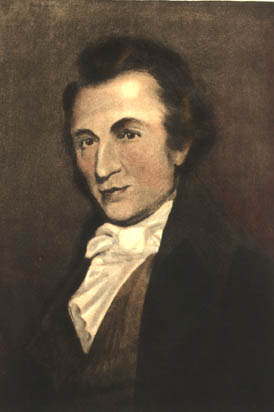
With respect to this particular portrait the editor of this blog cannot pretend to absolute certainty because there exists no comprehensive catalog of the known portraits of Thomas Paine. To my recollection, Conway is the only author/scholar to write about the subject in any depth and his account (found at the end of his Paine bio) is inadequate and quite outdated. Many more portraits are now known, but the attributions on just as many are confused or controversial. The editor is in possession of a considerable file on the subject, has learned in the process that a descriptive catalog or bibliography is a greater task than appears at first blush and would welcome the collaboration of another scholar or enthusiast for the eventual realization of such a work -- I'm not getting any younger.
The portrait is correctly attributed, I believe, to Charles Wilson Peale (April 15, 1741 – February 22, 1827), who knew Paine. There is or was a copy of it hanging in Constitution Hall -- I believe I recall seeing it there some years ago. Conway wrote -- on what authority he does not say -- that the latter is a second copy by Peale. The original is said to hang in the Second Bank of the United States in Philadelphia, now an important Portrait Gallery of paintings by Charles Wilson Peale.
You will sometimes also see it attributed to Bass Otis (July 17, 1784 - November 3, 1861), but if Otis painted one -- and I don't pretend to know to a certainly -- it would logically been a copy or study.
Nobody, to my knowledge, has ever done a thorough analysis of the extant and/or earliest copies of this work or any other Paine portrait. There must be material enough among them for any number of monographs, dissertations or other studies by present-day or aspiring scholars and art historians.
Thursday, April 14, 2011
Thomas Paine, Arthur O'Conner and the Rebellion of 1798
While transported to prison for his part in the Rebellion of 1798, Arthur O'Conner of the United Irishmen penned the following lines. While an apparently loyal panegyric to crown and country, it was meant to be read in the order indicated in the lines below:
1 The pomp of courts and pride of kings,
3 I prize above all earthly things,
5 I love my country, but the king --
7 Above all men his praise I sing,
9 The royal banner are displayed,
11 And may success the standard aid
2 I fain would banish far from hence,
4 The rights of man and common sense
6 Confusion to his odious reign
8 That foe of princes Thomas Paine
10 Defeat and ruin seize the cause,
12 Of France, its liberties and laws
1 The pomp of courts and pride of kings,
3 I prize above all earthly things,
5 I love my country, but the king --
7 Above all men his praise I sing,
9 The royal banner are displayed,
11 And may success the standard aid
2 I fain would banish far from hence,
4 The rights of man and common sense
6 Confusion to his odious reign
8 That foe of princes Thomas Paine
10 Defeat and ruin seize the cause,
12 Of France, its liberties and laws
Wednesday, April 6, 2011
Thomas Paine and Phillis Wheatley
Thanks to Rosemary Braun for pointing this out:
"In April 1776, Thomas Paine published Phillis' poem to George Washington in The Pennsylvania Magazine."
Roberts, Jamie. "Phillis Wheatley's Journey to Greatness" in American Spirit 145:1 (Jan/Feb, 2011), pp. 46-48.
"In April 1776, Thomas Paine published Phillis' poem to George Washington in The Pennsylvania Magazine."
Roberts, Jamie. "Phillis Wheatley's Journey to Greatness" in American Spirit 145:1 (Jan/Feb, 2011), pp. 46-48.
Subscribe to:
Posts (Atom)

 Posts
Posts