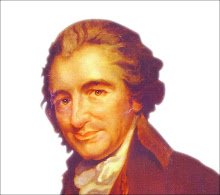
Another of these viral emails was forwarded to me today supposed chock full of juicy Thomas Jefferson quotations that show he was a pistol-packing, government hating, social security despising Tea-bagger. My beloved Uncle Bud and Aunt Marjie were the instigators and I'm CERTAIN that they fully expected me to debunk the whole thing. I did. And decided to post it here for posterity. The email begins with a Jefferson timeline and then a collection of quotes. From the collection:
**********
"The democracy will cease to exist when you take away from those who are willing to work and give to those who would not."
-- Thomas Jefferson
This quotation first appeared in Dreams Come Due: Government and Economics as if Freedom Mattered (New York: Simon & Schuster, 1986), p. 312, written under the pseudonym of John Galt. It is there attributed to Jefferson, but is not found anywhere in his works.
**********
"It is incumbent on every generation to pay its own debts as it goes. A principle which if acted on would save one-half the wars of the world."
-- Thomas Jefferson
I cannot locate this quotation anywhere in Jefferson's works nor can I locate a single quotation where he uses the word "incumbent." Doubtful to say the least.
**********
"I predict future happiness for Americans if they can prevent the government from wasting the labors of the people under the pretense of taking care of them." -- Thomas Jefferson
Baloney. This is misquote: "If we can prevent the government from wasting the labors of the people, under the pretense of taking care of them, they must become happy." Letter to Thomas Cooper (29 November 1802)
**********
"My reading of history convinces me that most bad government results from too much government." -- Thomas Jefferson
More baloney.
Motto of United States Magazine and Democratic Review. First used in introductory essay by editor John L. O'Sullivan in the premier issue (October, 1837, p. 6). Attributed to Jefferson by Henry David Thoreau, this statement is cited in his essay on civil disobedience, but the quote has not been found in Jefferson's own writings. It is also commonly attributed to Thomas Paine, perhaps because of its similarity in theme to many of his well-documented expressions such as "Society in every state is a blessing, but government even in its best state is but a necessary evil; in its worst state an intolerable one."
Variant: That government is best which governs least.
**********
"No free man shall ever be debarred the use of arms." -- Thomas Jefferson
Seriously inaccurate. The actual quotation with citation is:
"No freeman shall be debarred the use of arms [within his own lands]."
DRAFT Constitution for Virginia (June 1776) This quote almost always appears with the parenthetical omitted and with the SPURIOUS extension, "The strongest reason for the people to retain their right to keep and bear arms is as a last resort to protect themselves against tyranny in government".
**********
"The strongest reason for the people to retain the right to keep and bear arms is, as a last resort, to protect themselves against tyranny in government." -- Thomas Jefferson
Spurious. See notation to previous quote.
**********
"To compel a man to subsidize with his taxes the propagation of ideas which he disbelieves and abhors is sinful and tyrannical." -- Thomas Jefferson
Just the kind of sloppy misquote that one expects from this kind of smarmy pseudo-patriotic claptrap. The actual quotation with its context here:
"Well aware that the opinions and belief of men depend not on their own will, but follow involuntarily the evidence proposed to their minds; that Almighty God hath created the mind free, and manifested his supreme will that free it shall remain by making it altogether insusceptible of restraint; that all attempts to influence it by temporal punishments, or burthens, or by civil incapacitations, tend only to beget habits of hypocrisy and meanness, and are a departure from the plan of the holy author of our religion, who being lord both of body and mind, yet choose not to propagate it by coercions on either, as was in his Almighty power to do, but to exalt it by its influence on reason alone; that the impious presumption of legislature and ruler, civil as well as ecclesiastical, who, being themselves but fallible and uninspired men, have assumed dominion over the faith of others, setting up their own opinions and modes of thinking as the only true and infallible, and as such endeavoring to impose them on others, hath established and maintained false religions over the greatest part of the world and through all time: That to compel a man to furnish contributions of money for the propagation of opinions which he disbelieves and abhors, is sinful and tyrannical." A Bill for Establishing Religious Freedom, Chapter 82 (1779). Published in The Works of Thomas Jefferson in Twelve Volumes, Federal Edition, Paul Leicester Ford, ed., New York: G. P. Putnam's Sons, 1904, Vol. 1, pp. 438–441
**********
Thomas Jefferson (supposedly) said in 1802:
"I believe that banking institutions are more dangerous to our liberties than standing armies.
If the American people ever allow private banks to control the issue of their currency, first by inflation, then by deflation, the banks and corporations that will grow up around the banks will deprive the people of all property - until their children wake-up homeless on the continent their fathers conquered."
With respect to the first half of this mangled mess:
The earliest known appearance of this quote is from 1895 (Joshua Douglass, "Bimetallism and Currency", American Magazine of Civics, 7:256). It is apparently a combination of paraphrases or approximate quotations from three separate letters of Jefferson (longer excerpts in sourced section):
I sincerely believe, with you, that banking institutions are more dangerous than standing armies...
Letter to John Taylor, 1816
The bank mania...is raising up a moneyed aristocracy in our country which has already set the government at defiance...
Letter to Josephus B. Stuart, 1817
Bank paper must be suppressed, and the circulating medium must be restored to the nation to whom it belongs.
Letter to John W. Eppes, 1813
With respect to the second half which reads:
If the American people ever allow private banks to control the issue of their currency, first by inflation, then by deflation, the banks and the corporations which grow up around them will deprive the people of all property until their children wake up homeless on the continent their fathers conquered.
Respectfully Quoted says this is "obviously spurious", noting that the OED's earliest citation for the word "deflation" is from 1920. The earliest known appearance of this quote is from 1935 (Testimony of Charles C. Mayer, Hearings Before the Committee on Banking and Currency, House of Representatives, Seventy-fourth Congress, First Session, on H.R. 5357, p. 799). It appears nowhere in Jefferson's works.
[Credit to Wikiquotes.org for the greatest portion of this information]
Monday, January 23, 2012


Saturday, January 7, 2012
Paine on freedom of opinion in religion and government
"When opinions are free, either in matters of government or religion, truth will finally and powerfully prevail." Thomas Paine, Age of Reason, pt. II.
Thursday, December 29, 2011
Thomas Paine on revelation.
"It is a contradiction in terms and ideas to call anything a revelation that comes to us at second hand, either verbally or in writing. Revelation is necessarily limited to the first communication. After this, it is only an account of something which that person says was a revelation made to him; and though he may find himself obliged to believe it, it cannot be incumbent on me to believe it in the same manner, for it was not a revelation made to me, and I have only his word for it that it was made to him."
- Thomas Paine, Age of Reason, Part 1
- Thomas Paine, Age of Reason, Part 1
Tuesday, December 20, 2011
Thomas Paine, utilitarian.
"For the first and great question, and that which involves every other in it, and from which every other will flow, is happiness."
Thomas Paine, The Forrester's Letters, 1776.
Thomas Paine, The Forrester's Letters, 1776.
Sunday, December 18, 2011
Thomas Paine -- an association of vices revisited.
[posted in honor of my friend Jim Lockhardt]
"An association of vices will reduce us more than the sword."
Thomas Paine, American Crisis IX, 1780.
Everyone understands, don't they, that the financial industry and "big corporate" are accomplices in the subversion of the Congress ... not to exclude the government more generally, the military and even off-book elements. The corruption of government is a symptom. The infection is undue influence and the means is money or, as it's sometimes called, power. This has been the case, incidentally, since the establishment of the 1789 Constitution, the law-of-the-land in name. Money is king, not law. The corruption of government is a symptom. The infection is undue influence and the means is money or, as it's sometimes called, power (repeated, with apologies, for emphasis). This is not rocket-science. On the one hand, Congress was bribed into deregulating the financial sector while, on the other hand, Chicago and Austrian school economists blew hot air in the pants of anyone naive enough to believe their recycled "show me the money" theories. Short on education and long on petty greed, Americans ignored history and allowed over one hundred years of hard-earned economic experience to go down the drain. Forty years of so-called free-market deregulation and what did we get? Trillions of dollars in exotic, non-productive financial instruments -- basically bets leveraged in different directions on crummy mortgages in an overheated housing bubble -- took down the economy. The bad mortgages were the initial domino. In terms of dollar amount (that's numbers of dominoes for you Fox News kool-aid drinkers out there), the bad mortgages and underwater homes are DWARFED by the vastly larger amounts of unfunded funny-money ... drrrrrr ... financial instruments that were placed as bets by both for and against them. Anyone that believes deregulation is the cure under these circumstances needs -- in my ever humble opinion, of COURSE -- an examination of the cranium. The cure begins with publicly funded elections. And from the day the decision was made, it was clear to me that the only legal solution to the Supreme Court's "Citizens United" and other corporate person-hood precedent is a constitutional amendment.The republic was lost a long time ago. We 'Muricans prefer a comfortable lie to the bald truth. It an oligarchy ... an aristocracy of money. If we decide to move towards a freer society and equality under the law -- in my view the synonym for free society is democratic republic -- then we're going to have to struggle for it. We don't have one now and the powers-that-be will go neither willingly nor easily from their preeminent positions.
"An association of vices will reduce us more than the sword."
Thomas Paine, American Crisis IX, 1780.
Everyone understands, don't they, that the financial industry and "big corporate" are accomplices in the subversion of the Congress ... not to exclude the government more generally, the military and even off-book elements. The corruption of government is a symptom. The infection is undue influence and the means is money or, as it's sometimes called, power. This has been the case, incidentally, since the establishment of the 1789 Constitution, the law-of-the-land in name. Money is king, not law. The corruption of government is a symptom. The infection is undue influence and the means is money or, as it's sometimes called, power (repeated, with apologies, for emphasis). This is not rocket-science. On the one hand, Congress was bribed into deregulating the financial sector while, on the other hand, Chicago and Austrian school economists blew hot air in the pants of anyone naive enough to believe their recycled "show me the money" theories. Short on education and long on petty greed, Americans ignored history and allowed over one hundred years of hard-earned economic experience to go down the drain. Forty years of so-called free-market deregulation and what did we get? Trillions of dollars in exotic, non-productive financial instruments -- basically bets leveraged in different directions on crummy mortgages in an overheated housing bubble -- took down the economy. The bad mortgages were the initial domino. In terms of dollar amount (that's numbers of dominoes for you Fox News kool-aid drinkers out there), the bad mortgages and underwater homes are DWARFED by the vastly larger amounts of unfunded funny-money ... drrrrrr ... financial instruments that were placed as bets by both for and against them. Anyone that believes deregulation is the cure under these circumstances needs -- in my ever humble opinion, of COURSE -- an examination of the cranium. The cure begins with publicly funded elections. And from the day the decision was made, it was clear to me that the only legal solution to the Supreme Court's "Citizens United" and other corporate person-hood precedent is a constitutional amendment.The republic was lost a long time ago. We 'Muricans prefer a comfortable lie to the bald truth. It an oligarchy ... an aristocracy of money. If we decide to move towards a freer society and equality under the law -- in my view the synonym for free society is democratic republic -- then we're going to have to struggle for it. We don't have one now and the powers-that-be will go neither willingly nor easily from their preeminent positions.
Saturday, December 3, 2011
Tuesday, October 18, 2011
Edward Gray on Tom Paine's Iron Bridge
Brief, charming and ACCURATE essay on Tom Paine's iron bridge:
http://www.common-place.org/vol-05/no-04/talk/
http://www.common-place.org/vol-05/no-04/talk/
Subscribe to:
Posts (Atom)

 Posts
Posts