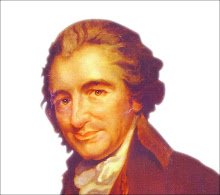
Showing posts with label X. Show all posts

Sunday, August 5, 2012

Was Thomas Paine depressed, drunk and diseased?

A 2011 article on a BBC website claims that

"Paine ... died in miserable circumstances in New York in 1809, having spent his last years in America often depressed, drunk and diseased."
http://www.bbc.co.uk/history/
british/empire_seapower/paine_01.shtml

The author of the BBC article is not the first historian to accept the common nineteenth-century account of Paine's circumstances and passing at the end of his life. Most of Paine's chief biographers -- including Conway, Keane and others -- have repeated it with little amelioration or critical analysis.

My reading of the historical data is that history and historians have fallen for what amounts to anti-Paine propaganda popularized in the Federalist and conservative press before, during and subsequent to Paine's death.

The fact is that Paine died a wealthy man. Paine's biographers have documented his financial worth at between $11,500.00 and $15,000.00 US at the time of his death ... a substantial amount at that time. Land accounted for about $10,000.00 of it, as I recall, but he was far from poor.

Nor was he any more or less alone than any of us are at the time of death.

Many of Paine's closest friends and associates were guillotined in the French Revolution and others died of old age and illness before him. He lived to a ripe old age in spite of serious infirmity brought
about by the ruination of his health during imprisonment. There is no reason to believe that he was  more "depressed" than any other elderly, dying person. In fact, those who actually knew him during the period spoke of his clarity, kindness, resignation and firmness of mind.

Nobody who actually knew him says he was drunken.

That accusation comes solely from his political enemies, chiefly James Cheetham whose notorious attack biography of Paine was an early milestone in yellow journalism. In the early 1800s, the story of Paine's drunkenness was so nearly universal that his early biographer Gilbert Vale accepted it when he first set out to write a biography. But in the course of research for his Life of Thomas Paine, Vale met many persons who actually knew Paine (John Fellows, Aaron Burr, the artist John Wesley Jarvis among them) and universally denied the allegation that Paine was drunken, filthy or particularly diseased. If you've not read Vale's account, it is a fascinating read.

Paine drank far less than either Washington or Jefferson. And yet we find no accounts of "Washington's filthy drunkenness" anywhere. Jarvis, with whom Paine lived in his old age, said that he himself drank FAR more than Paine and the New Rochelle store clerk who drove Paine's carriage and actually sold him his liquor and assisted him when he was ill says he never once saw Paine drunk ... ever. This at a time when Federalist sources say he was soused. Don't forget that for the temperance advocates of Paine's and later ages, just one drink was debauchery itself. Paine was known at that time to purchase about a quart of BRANDY per week for himself and friends and to take a glass of brandy and water after what we now call lunch and one again after supper. The fact
is that prudish, evangelical, pro-temperance and most of all FEDERALIST writers attacked Paine's personal character in order to blunt his political influence .... just as they do today.

This is not to say (begging your pardon) that Paine farted roses and butterflies. He was a human being ... which is to say, a complex being. Gilbert Vale had it about right:

"We are not, however, about to write a eulogy; to enhance his virtues, or to suppress his faults, or vices. Paine was a part of human nature, and partook of its imperfections; and our purpose is to fairly represent him as he was; but the greater part of Paine's life was public and as such we know of no man who had greater virtues or less vices."

What Vale found and documented in his own research on Paine -- and no biographer has added substantially or significantly to Vale's account -- was that virtually all of the received accounts of Paine's drunkenness traced back to James Cheetham's smear. Cheetham was a convicted libeler. Paine threatened to sue him when alive. Cheetham waited to write his defamatory historical novel until after Paine's death ... in fact, immediatelyafter Paine's death in order to maximize his sales.

Janet Mirsky and Allan Nevins, in their distinguished biography of Eli Whitney noted Whitney's disgust with Paine's shaking hand and drooping lip as he raised a glass of wine. Mirsky and Nevins, however, suggested that Whitney the Federalist and temperance advocate .. ignorant of medicine ...
mistook Paine's palsy. He had recently hurt himself in a fall down a flight of stairs after what he described as a "fit of apoplexy" that left him without the ability to speak or use his hands for some days. This was almost certainly a stroke. Mirsky, Nevins and other credible medical observers believe that he may have had Parkinson's and the conservative Whitney's disgust was prejudicial and medically oblivious.

A question: wouldn't it be more balanced, judicious and historically reasoned to say with Gilbert Vale that

"... he died in peace, in a good old age, the firm and consistent friend
of liberty."

and that to write otherwise is to perpetuate what was originally a politically motivated slander?

© Kenneth W. Burchell 2012, All Rights Reserved.

[note: the blogger has written the author of the BBC article and awaits reply. Interested persons can find another elaboration of this argument in the introduction to my six-volume, fully edited collection of contemporary American replies to Thomas Paine: http://www.pickeringchatto.com/major_works/thomas_paine_and_america_1776_1809 and my critique of a more recent shibboleth on Paine's supposed depression is here http://kenburchell.blogspot.com/p/thomas-paine-and-bi-polar-disorder.html ]

Saturday, July 4, 2009

Thomas Paine - Call me rebel.

"Let them call me rebel and welcome, I feel no concern from it; but I should suffer the misery of devils, were I to make a whore of my soul ..." -- Thomas Paine, American Crisis I.

Liberty in chains

Detail of a cartoon by nineteenth-century American artist Watson Heston. Note: image is © Kenneth W. Burchell 2009, All Rights Reserved.

Fourth of July -- Thomas Paine on patriotism

"There is not a vice, nor scarcely a virtue, that has not as the fashion of the moment suited been called by the name of patriotism ... But if we give to patriotism a fixed idea consistent with that of a republic, it would signify a strict adherence to the principles of moral justice, to the equality of civil and political rights, to the system of representative government, and an opposition to every hereditary claim to govern; and of this species of patriotism you know my character." Thomas Paine to James Monroe - October 26, 1794.

Thursday, July 2, 2009

Thomas Paine - Lewes

Terrific article from the Washington Post on Thomas Paine and Lewes:

http://www.washingtonpost.com/wp-dyn/content/article/2009/06/26/AR2009062601602.html

Thomas Paine and Bi-polar Disorder

Thomas Paine and Bi-polar Disorder --

"The course of his biography, with its episodes of buoyant enthusiasm and mute withdrawal, as well as eyewitness accounts of his alternately voluble and determinedly silent behavior, imply that Paine may have suffered from a form of bipolar disorder."

Nelson, Craig. Thomas Paine: Enlightenment, Revolution, and the Birth of Modern Nations. NY: Viking, 2006.

Comment:
Craig Nelson's proposition that Paine "may" have had bi-polar disorder
strikes me as the latest in a long history of strained interpretations starting with the accusation of his impotence by Tory hack-writer George Chalmers aka Francis Oldys and continuing to the present time with the turgid and imaginative screenplay -- admittedly interpretive art, not history -- of Trevor Griffiths. Why strain for an interpretation when, as Paine pointed out, the shortest distance between two points is a straight line?

Some degree of psychological analysis is doubtless appropriate where we have enough information to speculate. Psychohistory has played a part in professional history since the first historian assigned a motive to an historical player. But the behavior that Mr. Nelson identified as bi-polar, it seems to me, has a much simpler and more convincing explanation. Paine was elderly, extremely ill and suffering intense physical pain during the times when he was emotionally "down" or in "mute withdrawal" -- seriously ill and in pain. This has not been enough emphasized in the literature -- partly because Paine did continue to write and frequently quite well despite his illness. Naturally we can't know from this distance with certainty whether he had depressive illness or not, but in my opinion, bi-polar disease is not the straightest line between two points.

Paine never recovered from the illness that befell him during his incarceration. Described as an abcess in the side, he was delirious or unconscious for weeks at a time. In 1797, well after his 1794 release, he relapsed and nearly died while in the care of James Monroe and his wife. Still later, a credible visitor described his still abcessed side, exposed rib and perfect agony. Nerve disease, palsy, and stroke wore away the last ten years of his life until he passed away in 1809. Despite this travail, Paine completed many valuable, piquant and revelatory writings, in particular Agrarian Justice, Dissertation on First Principles of Government, and his eight Letters to the Citizens of the United States. If in some of his later work, the sounds at times impatient, abrupt, cranky or short, then we well know the source and perhaps admire his determination to be of earthly good unto the end of his life.

Monday, June 22, 2009

The United States of America needs a new political party born of the unfinished business of the American Revolution -- much like Horace Greeley said of the Republican Party when it was created back in the mid 1850s. The Republican Party was originally created to resolve the issue of slavery versus free labor, free land, free speech and free people. The Whig and Democratic Parties failed to resolve the issue and both shattered over internal divisions. The Republican Party that arose in their stead was originally pro-tariff and anti-slavery. The two great American political issues of the Nineteenth Century were slavery and banking. The slavery issue -- at least chattel slavery -- was solved, but the issue of wage-slavery and banking exploitation was never resolved. In fact, I would argue that the bank monopolies prevailed. Study the debates in that surrounded creation of Hamilton's first Bank of the United States. The Congress of the United States farmed out its constitutional currency creating powers to a private banking corporation, setting off a two-hundred year struggle that still threatens to collapse the remains of the republic. Unless we mobilize the citizenry, the international banking/financial interests will extinguish the U. S. before the U. S. can begin to extinguish the banking cartels.

Friday, June 19, 2009

Another phony Thomas Paine quote

The following quote is presently proliferating around the web as attributed to Thomas Paine: “A patriot must always be ready to defend his country against his government.” The quote is not Thomas Paine: it's from Edward Abbey.

Thursday, June 18, 2009

Impoverished Paine - NOT!

On the subject of Paine's supposed impoverishment at death, the administration of his will showed that he was worth conservatively about $8000.00 in currency of the time. In today's dollars that would be worth about $141,000.00. Not bad and not poverty by any stretch.

Wednesday, June 17, 2009

The object of Revolution - Thomas Paine

"Revolutions have for their object, a change in the moral condition of governments." Thomas Paine - Rights of Man II, 1792.