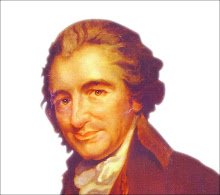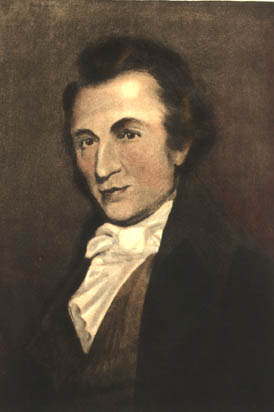
In reply to two colleagues who recently inquired about the identity of the painter of this portrait of Thomas Paine:
With respect to this particular portrait the editor of this blog cannot pretend to absolute certainty because there exists no comprehensive catalog of the known portraits of Thomas Paine. To my recollection, Conway is the only author/scholar to write about the subject in any depth and his account (found at the end of his Paine bio) is inadequate and quite outdated. Many more portraits are now known, but the attributions on just as many are confused or controversial. The editor is in possession of a considerable file on the subject, has learned in the process that a descriptive catalog or bibliography is a greater task than appears at first blush and would welcome the collaboration of another scholar or enthusiast for the eventual realization of such a work -- I'm not getting any younger.
The portrait is correctly attributed, I believe, to Charles Wilson Peale (April 15, 1741 – February 22, 1827), who knew Paine. There is or was a copy of it hanging in Constitution Hall -- I believe I recall seeing it there some years ago. Conway wrote -- on what authority he does not say -- that the latter is a second copy by Peale. The original is said to hang in the Second Bank of the United States in Philadelphia, now an important Portrait Gallery of paintings by Charles Wilson Peale.
You will sometimes also see it attributed to Bass Otis (July 17, 1784 - November 3, 1861), but if Otis painted one -- and I don't pretend to know to a certainly -- it would logically been a copy or study.
Nobody, to my knowledge, has ever done a thorough analysis of the extant and/or earliest copies of this work or any other Paine portrait. There must be material enough among them for any number of monographs, dissertations or other studies by present-day or aspiring scholars and art historians.
Wednesday, April 27, 2011
Thursday, April 14, 2011
Thomas Paine, Arthur O'Conner and the Rebellion of 1798
While transported to prison for his part in the Rebellion of 1798, Arthur O'Conner of the United Irishmen penned the following lines. While an apparently loyal panegyric to crown and country, it was meant to be read in the order indicated in the lines below:
1 The pomp of courts and pride of kings,
3 I prize above all earthly things,
5 I love my country, but the king --
7 Above all men his praise I sing,
9 The royal banner are displayed,
11 And may success the standard aid
2 I fain would banish far from hence,
4 The rights of man and common sense
6 Confusion to his odious reign
8 That foe of princes Thomas Paine
10 Defeat and ruin seize the cause,
12 Of France, its liberties and laws
1 The pomp of courts and pride of kings,
3 I prize above all earthly things,
5 I love my country, but the king --
7 Above all men his praise I sing,
9 The royal banner are displayed,
11 And may success the standard aid
2 I fain would banish far from hence,
4 The rights of man and common sense
6 Confusion to his odious reign
8 That foe of princes Thomas Paine
10 Defeat and ruin seize the cause,
12 Of France, its liberties and laws
Wednesday, April 6, 2011
Thomas Paine and Phillis Wheatley
Thanks to Rosemary Braun for pointing this out:
"In April 1776, Thomas Paine published Phillis' poem to George Washington in The Pennsylvania Magazine."
Roberts, Jamie. "Phillis Wheatley's Journey to Greatness" in American Spirit 145:1 (Jan/Feb, 2011), pp. 46-48.
"In April 1776, Thomas Paine published Phillis' poem to George Washington in The Pennsylvania Magazine."
Roberts, Jamie. "Phillis Wheatley's Journey to Greatness" in American Spirit 145:1 (Jan/Feb, 2011), pp. 46-48.
Sunday, March 27, 2011
Thomas Paine on Natural Religion
"It is only in the creation that all our ideas and conceptions of a word of God can unite. The creation speaketh a universal language, independently of human speech or human language, multiplied and various as they may be. It is an ever-existing original, which every man can read. It cannot be forged; it cannot be counterfeited; it cannot be lost; it cannot altered; it cannot be suppressed. It does not depend upon the will of man whether it shall be published or not: it publishes itself from one end of the earth to the other. It preaches to all nations and to all worlds; and this word of God reveals to man all that is necessary for man to know of God." Thomas Paine, Age of Reason, Pt. 1, 1794
Thursday, March 17, 2011
New home for the Thomas Paine Collection in Iona College Library
The collection of pamphlets, books, ephemera, artifacts, journals and other writings formerly the collection of the now defunct Thomas Paine Museum of New Rochelle, New York finally found an home at the Iona College Library. Amidst the controversy over the sell-off of some of its most valuable and rare holdings, the collection was first moved to the New York State Historical Society while what is known as a 511 Hearing took place in the Superior Court of the State of New York in order to determine the appropriate and safest site for relocation and care of the collection.
Friends of this blog will recall a number posts on the subject under discussion, among them
http://kenburchell.blogspot.com/2009/06/thomas-paine-museum-new-rochelle-update.html
A spokesman for the Office of the Attorney General of the State of New York later repudiated the notion that any kind of "deal" was made, preferred to speak in terms of an "agreement," and emphasized that all of the actions were "voluntary." As it turns out, all seven points of the supposedly voluntary agreement -- reported here on this blog -- have held true, with the result that what is now being called The Thomas Paine Collection was at last quietly moved to Iona College. Other than the new page or two on Iona College's website, there seems to have been little or no fanfare, not even a press release.
A point with regard to the name -- perhaps a bit overstated, it harks back to the bad old days of the body that formerly held the collection, the Thomas Paine National Historical Association (TPNHA) of now controversial if not permanently tarnished reputation. Back during the time when it was a functioning -- if mostly contentious -- organization, the Burton/McCartin "leadership" was forever generating inflated claims for the association and for Thomas Paine, among them the hoary old shibboleth of their cohort ... that it was Thomas Paine who actually "authored the Declaration of Independence." Perhaps there are echos of that same tendency to overstate in the present name for this assemblage of evidently 200 items, "The Thomas Paine Collection." A far more comprehensive and important collection of original Paine material, for example, is archived at the Library of the American Philosophical Society of Philadelphia, Pennsylvania; the Colonel Richard Gimbel Collection of Thomas Paine Papers. On the other hand, some of the finest holdings of the TPNHA were disposed of in the controversial sell-off while other items they claimed -- such as Paine's writing-trunk, spectacles and other artifacts -- are, to the best of my knowledge, without provenance. Unless they can be positively documented, Paine's supposed ownership will be just another enormous but unsupportable claim. Certainly it would be wonderful if the trunk and other items prove to be Paine's, but even if the can be thus established, this is nothing like "THE Thomas Paine Collection." Just a suggestion -- perhaps it would be better to add a qualifier and call it "The Thomas Paine Collection at Iona College" or something along those lines.
More will doubtless follow. All Thomas Paine all the time here at the Thomas Paine Review.
Friends of this blog will recall a number posts on the subject under discussion, among them
http://kenburchell.blogspot.com/2009/06/thomas-paine-museum-new-rochelle-update.html
A spokesman for the Office of the Attorney General of the State of New York later repudiated the notion that any kind of "deal" was made, preferred to speak in terms of an "agreement," and emphasized that all of the actions were "voluntary." As it turns out, all seven points of the supposedly voluntary agreement -- reported here on this blog -- have held true, with the result that what is now being called The Thomas Paine Collection was at last quietly moved to Iona College. Other than the new page or two on Iona College's website, there seems to have been little or no fanfare, not even a press release.
A point with regard to the name -- perhaps a bit overstated, it harks back to the bad old days of the body that formerly held the collection, the Thomas Paine National Historical Association (TPNHA) of now controversial if not permanently tarnished reputation. Back during the time when it was a functioning -- if mostly contentious -- organization, the Burton/McCartin "leadership" was forever generating inflated claims for the association and for Thomas Paine, among them the hoary old shibboleth of their cohort ... that it was Thomas Paine who actually "authored the Declaration of Independence." Perhaps there are echos of that same tendency to overstate in the present name for this assemblage of evidently 200 items, "The Thomas Paine Collection." A far more comprehensive and important collection of original Paine material, for example, is archived at the Library of the American Philosophical Society of Philadelphia, Pennsylvania; the Colonel Richard Gimbel Collection of Thomas Paine Papers. On the other hand, some of the finest holdings of the TPNHA were disposed of in the controversial sell-off while other items they claimed -- such as Paine's writing-trunk, spectacles and other artifacts -- are, to the best of my knowledge, without provenance. Unless they can be positively documented, Paine's supposed ownership will be just another enormous but unsupportable claim. Certainly it would be wonderful if the trunk and other items prove to be Paine's, but even if the can be thus established, this is nothing like "THE Thomas Paine Collection." Just a suggestion -- perhaps it would be better to add a qualifier and call it "The Thomas Paine Collection at Iona College" or something along those lines.
More will doubtless follow. All Thomas Paine all the time here at the Thomas Paine Review.
Monday, March 14, 2011
Gilbert Vale on Thomas Paine
"Other men have followed events; Paine actually created them." Gilbert Vale, The Life of Thomas Paine (New York: published by the author, 1839), p. 34.
Wednesday, March 9, 2011
Thomas Paine on wealth, riches, and affluence.
"The contrast of affluence and wretchedness continually meeting and offending the eye, is like dead and living bodies chained together. Though I care as little about riches as any man, I am a friend to riches because they are capable of good." Thomas Paine, Agrarian Justice, 1797.
Subscribe to:
Comments (Atom)